Local Marketplaces
- Tmall Global
- JD Worldwide
- Pinduoduo
- Douyin Mağaza
- Taobao
- Xiaohongshu
- Kaola
- Vipshop
- Suning
- WeChat Channels
- Temu


Website design prices start at €990 a year — hosting, SSL, maintenance and support included.
From a Shanghai Jing'an dental clinic to a Shenzhen Nanshan law office — corporate websites with the ICP filing handled, hosted inside China and tuned for Baidu.
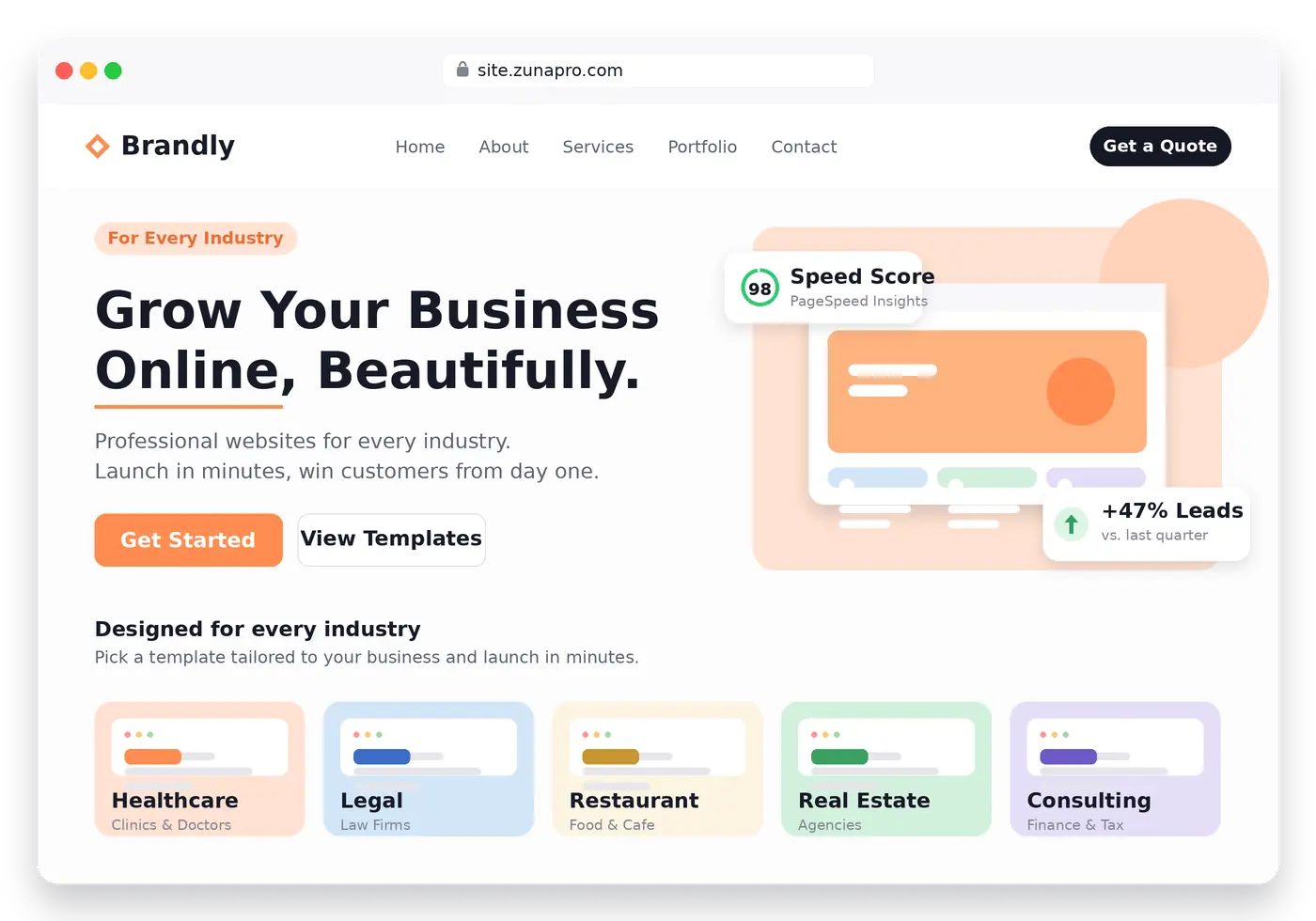
Every profession has different web needs. A vet site differs from a lawyer site in structure, content and booking flow. Work with someone who knows your industry.
Booking form, services, team intro
Explore →Treatment pages, before/after, prices
Explore →Pet records, vaccine schedule, contact
Explore →Practice areas, references, intake form
Explore →Service plans, client portal, live chat
Explore →Menu, reservations, location, ordering
Explore →Project portfolio, team, quote form
Explore →Room photos, booking integration
Explore →Service list, online booking, offers
Explore →Listings, service booking, price list
Explore →Catalog, on-call info, online form
Explore →Listings, virtual tour, valuation form
Explore →
A Hangzhou WFOE needs its ICP 备案 number in the footer and a WeChat customer-service entry; a Guangzhou restaurant needs a menu, a map and a WeChat Mini Program booking link. We walk you through the ICP filing/licence process and design around these sector reflexes — never a generic template.
We build and keep it fast. Mainland hosting with a domestic CDN — offshore servers crawl through the Great Firewall — plus WeChat Official Account and Mini Program integration, Baidu Webmaster submission with ranking tracking, a PIPL-compliant cookie and data-consent policy, and a monthly Baidu search performance report.
Hosting, SSL, speed optimization, SEO foundation and technical maintenance — all in one plan.

Google-loved speed scores. Auto sitemap, schema.org and meta tags.

Perfect on every device. 70% of your customers visit on mobile.

Booking, quote and contact forms — WhatsApp and email notifications.

Free SSL certificate, DDoS protection and regular backups included.

No-code panel. Update text, photos and prices yourself.

Google Maps, Instagram feed and social share buttons.
Local marketplaces, carriers, payment methods and compliance frameworks — from a single panel
All plans are annual. Hosting, SSL, maintenance and support included.
For new and small businesses
For growing multi-page sites
For fully custom design and integrations
Annual billing · Free setup · Hosting & SSL included
Zunapro's website design prices are annual and come in three packages: Starter €990, Corporate €2,790 and Premium €4,900 per year, VAT included. Every package includes hosting, an SSL certificate, a mobile-friendly design, basic SEO, maintenance and technical support; setup is free and there are no monthly add-on fees. Small businesses usually choose Starter, multi-page company sites Corporate.
Any website hosted on mainland Chinese servers must complete an ICP 备案 (filing), and the applicant needs a Chinese business licence — foreign investors usually file through a WFOE or a joint venture. A brochure site only needs the filing; if you sell or charge online you need the commercial ICP licence (ICP证). We prepare the paperwork and follow up with the telecom authority; the process typically takes 2-4 weeks.
Yes — .cn registration requires real-name verification: a business licence for companies, an ID document for individuals. For a China-facing site we keep the .cn and .com.cn under the same entity as your ICP filing, otherwise the filing gets rejected. DNS stays with a mainland provider so domestic resolution remains fast.
Baidu strongly favours ICP-filed sites hosted in China, Simplified Chinese content and fast domestic load times, so Google-style link building does not transfer. We submit your site and sitemap to Baidu Webmaster Tools, run Baidu Tongji analytics and build landing pages for Shanghai, Beijing and Shenzhen city queries. Baidu also applies its own HTTPS and mobile-adaptation rules, which we configure to spec.
Yes. We add an Official Account follow entry and WeChat customer-service chat to the site, and when you need bookings or a storefront we build a companion Mini Program sharing the same content backend. Menus, template messages and Mini Program links are all submitted per WeChat's review guidelines so your launch is not rejected.
For mainland visitors we recommend Alibaba Cloud or Tencent Cloud nodes inside China plus a domestic CDN — offshore servers pass through the Great Firewall and load slowly or unreliably. A Hong Kong server needs no ICP filing and launches fast, but mainland speed is clearly worse, so it only works as a transition while your filing is pending. We stage the hosting plan around your filing progress.
PIPL requires separate consent before collecting personal information, so we deploy compliant consent prompts on forms and cookies with a Chinese-language privacy policy. If data flows abroad — say to a Turkish or European headquarters — we design the transfer under PIPL's cross-border rules and disclose it. Analytics defaults to domestic tooling (Baidu Tongji) so no blocked offshore script slows the page.
A standard corporate site usually goes live 2-3 weeks after the ICP filing clears; quotes are in CNY and we can issue an e-Fapiao (数电发票). For online collections we integrate Alipay and WeChat Pay, and the maintenance plan covers content updates, security patches and a monthly Baidu search performance report.
A corporate website that works in China obeys a different rulebook. Google, Facebook and most Western CDNs are unreachable, Baidu answers the overwhelming majority of searches, and a site hosted outside the mainland crawls through the Great Firewall. Add the mandatory ICP filing, .cn real-name verification, the WeChat ecosystem and PIPL consent rules, and it becomes clear why a template built for European visitors fails in Shanghai. This guide walks through the full build: the ICP process step by step, the hosting decision tree, Baidu SEO, WeChat integration and compliant cross-border data flows.
China has over a billion internet users, and almost none of them experience your existing .com the way a visitor from Berlin or Istanbul does. Google holds a marginal share of search; Baidu dominates. Google Fonts, Google Maps, YouTube embeds, reCAPTCHA and most Western analytics scripts are blocked outright.
The consequence is architectural, not cosmetic. A China-ready corporate site is hosted on the mainland, filed with the telecom authority, written in Simplified Chinese first, integrated with WeChat instead of WhatsApp, measured with Baidu Tongji instead of Google Analytics, and legally anchored in PIPL rather than GDPR. Every one of these choices must be made at project start, because retrofitting them later usually means rebuilding.
Any website served from mainland Chinese servers must complete an ICP 备案 (filing) before launch — hosting providers will not open web traffic to an unfiled domain. The application runs through your hosting provider to the provincial communications administration and typically takes two to four weeks. The sequence in practice:
A brochure or corporate site only needs the filing. The moment you sell or charge for services online, you need the commercial ICP licence (ICP证) — a heavier value-added telecom permit with stricter shareholder conditions. Knowing which one applies before you start saves weeks.
The filing applicant needs a business licence issued in China. A foreign company cannot file with its home-country registration: it files through a Chinese vehicle, usually a WFOE (wholly foreign-owned enterprise) or a joint venture with a local partner. A representative office is generally unsuitable because it may not conduct commercial activity.
If you do not yet have an entity, sequence matters: incorporate first, then file, then launch. ZunaPro coordinates the website project with company formation so the business licence, the domain ownership and the ICP filing all land under the same legal name — mismatched names are the single most common reason filings get rejected.
Where the site physically lives decides speed, legality and time-to-launch. This is the comparison we walk every client through:
| Option | ICP required | Mainland speed | Time to launch | Best for |
|---|---|---|---|---|
| Mainland (Alibaba/Tencent Cloud) | Yes | Excellent | 2-4 weeks after filing | Primary long-term setup |
| Hong Kong node | No | Moderate, inconsistent | Days | Transition while filing is pending |
| Offshore (EU/US) | No | Poor via Great Firewall | Days | Not recommended for a China audience |
The pragmatic pattern for companies in a hurry: go live on a Hong Kong node in week one while the WFOE paperwork and ICP filing progress, then migrate to a mainland node with a domestic CDN once the filing number arrives. We stage DNS and content so that migration is an afternoon, not a rebuild.
.cn and .com.cn registrations require real-name verification: a business licence for companies, an ID document for individuals. For a China-facing site the domain must sit under the same legal entity as the ICP filing — a mismatch is grounds for rejection. We keep DNS with a mainland provider so domestic resolution stays fast, and we keep your international .com untouched for the rest of the world.
Cross-border links into China are congested and throttled, so every offshore asset on your page is a liability. We strip blocked dependencies — Google Fonts, Google Maps, reCAPTCHA, YouTube embeds, Western tag managers — and replace them with self-hosted fonts, Amap or Baidu Maps, domestic captcha and Baidu Tongji.
A domestic CDN (available only to ICP-filed domains) then distributes assets across nodes in Shanghai, Beijing, Shenzhen, Guangzhou, Hangzhou and Chengdu. Our target is a sub-two-second first render in every tier-one city — which Baidu also rewards directly in ranking.
Baidu strongly favours ICP-filed sites hosted in China, Simplified Chinese content and fast domestic load times. Google-style link building does not transfer; indexing is slower and needs active help. We verify the site in Baidu Webmaster Tools, submit the sitemap, use the active push API for new pages and run Baidu Tongji for analytics — the domestic stack from day one.
Content strategy differs too: we build dedicated landing pages for city queries — Shanghai, Beijing, Shenzhen — because Chinese B2B search behaviour is heavily location-qualified. Baidu also applies its own HTTPS and mobile-adaptation rules, and we configure both to its published spec rather than assuming Google best practice carries over.
In China the website rarely stands alone — WeChat is the operating system of daily business life. We register and connect a WeChat Official Account, place a follow entry and a WeChat customer-service chat on the site, and bridge offline touchpoints with QR codes on business cards, packaging and storefronts. For a Chinese prospect, a company without an Official Account reads like a company without a phone number.
When you need bookings, appointments or a storefront, we build a companion WeChat Mini Program that shares the website's content backend, so prices and copy never drift apart. Menus, template messages and Mini Program links are submitted per WeChat's review guidelines, so the launch is not rejected at the last step.
PIPL, China's Personal Information Protection Law, requires separate consent before personal information is collected. We deploy compliant consent prompts on contact forms and cookies and write the privacy policy in Chinese — a translated GDPR text does not satisfy the standard.
If form data flows abroad — say to a Turkish or European headquarters CRM — we design the transfer under PIPL's cross-border rules and disclose it explicitly. Analytics defaults to domestic tooling, which keeps both the regulator and the page-speed budget happy: no blocked offshore script, no silent data export.
Most foreign-invested companies need the site to serve two audiences: Chinese customers, partners and regulators on one side, the international headquarters and investors on the other. The pattern that works is Simplified Chinese as the primary language, natively written — never machine-translated — with an English mirror for international stakeholders. Many groups run a split-domain architecture: the global .com stays on its existing offshore infrastructure while the China site lives on the mainland under .cn or .com.cn, with shared branding and design so the company reads as one firm on both sides of the firewall.
The realistic sequence: entity in place (or formed with our formation team), domain registered and real-name verified, ICP filing submitted, design and build running in parallel — and the site live two to three weeks after the filing clears. Quotes are in CNY and we can issue an e-Fapiao (数电发票); if you collect payments online we integrate Alipay and WeChat Pay.
After launch, the maintenance plan covers content updates, security patches and a monthly Baidu search performance report, with WeChat and Mini Program upkeep in the same hands. One team for site, ecosystem and compliance.
Our experts map out your path in marketplace integration, e-commerce and company formation — free, no obligation.
Get Free Consultation →