Local Marketplaces
- Tmall Global
- JD Worldwide
- Pinduoduo
- Douyin Mağaza
- Taobao
- Xiaohongshu
- Kaola
- Vipshop
- Suning
- WeChat Channels
- Temu


A China-ready store for Shanghai and Shenzhen — Alipay and WeChat Pay at checkout, SF Express and JD Logistics labels, ICP filing guidance and a WeChat Mini Program storefront from day one.
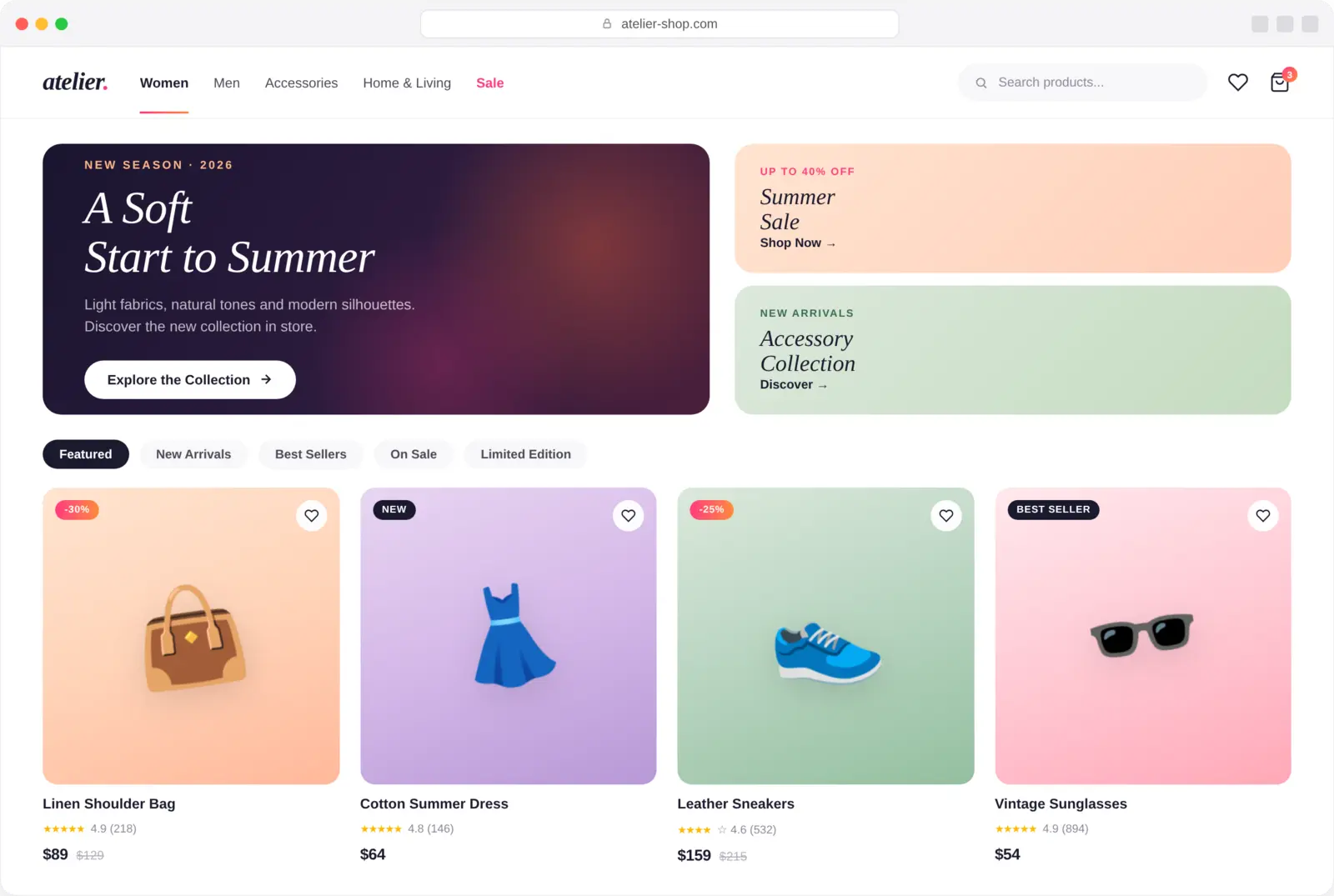
Integrated with leading China brands
Tailored Solution
Themes for Hangzhou beauty, Shenzhen electronics or Chengdu food brands. 增值税 (VAT) applies automatically at 13/9/6% by category, every order issues an e-Fapiao (数电发票), and a PIPL-compliant consent flow ships standard for your WFOE or 有限公司.
Hands-On Support
Alipay and WeChat Pay together cover over 90% of Chinese online payments, with Huabei and JD Baitiao unlocking installments. SF Express and JD Logistics print labels automatically with Cainiao tracking, and the store mirrors into a WeChat Mini Program to reach a billion-user ecosystem.
Flexible plans that grow with you. Upgrade or cancel anytime.
For getting started
Most popular for growing brands
Complete package for high-volume sellers
Pay monthly · Free setup · Cancel anytime
Manage your entire operation from one panel. No third-party plugins required.

Industry-specific mobile-ready themes — go live in hours.

Sync orders and stock with the most popular marketplaces in China.

Stripe, PayPal and local gateways. 3D Secure and installments included.

Print labels, send tracking codes automatically — all major carriers included.

Country-compliant e-invoicing, automatic income/expense, accountant access.

95+ Lighthouse score, automatic sitemap, schema.org, AMP support.
Local marketplaces, carriers, payment methods and compliance frameworks — from a single panel
If your site is hosted on mainland Chinese servers, ICP filing (备案) is a legal prerequisite — typically submitted through your host such as Aliyun or Tencent Cloud and approved within 1-3 weeks. Commercial selling sites may additionally need the ICP commercial licence (ICP经营许可证). Hosting in Hong Kong avoids the filing but costs you speed, so we recommend the compliant route that matches your entity.
Yes. Alipay and WeChat Pay together cover over 90% of Chinese online payments, and both ship in the default checkout alongside UnionPay cards and Huabei / JD Baitiao installments. Opening the merchant accounts requires a Chinese business licence (a WFOE or 有限公司), and we guide the merchant onboarding while the store is being built.
The store applies 增值税 automatically by category: 13% for general goods, 9% for agricultural products and similar, 6% for modern services. Every paid order can issue the nationwide digital e-Fapiao (数电发票) automatically — no paper invoices, with the document pushed to the buyer and archived to your bookkeeping.
For the best mainland load times we host on Aliyun or Tencent Cloud nodes with the ICP filing completed, pairing an in-country CDN that keeps first paint around one second. In cross-border mode you can start on a Hong Kong node and switch to mainland architecture once the filing clears.
Yes. A PIPL-compliant separate-consent dialog, privacy policy and user data export/deletion flow ship as standard. If personal data leaves China, the CAC's cross-border rules require a security assessment or standard-contract filing — the store pre-wires the corresponding notices and toggles.
Yes. Under the CBEC retail-import model goods ship from a bonded warehouse or by direct mail and are taxed under the consolidated cross-border rate, with a ¥5,000 per-order and ¥26,000 annual per-buyer quota. You can start without a Chinese entity and upgrade to a WFOE as volume grows.
SF Express and JD Logistics deliver next-day or even same-day in tier-1 cities like Shanghai and Shenzhen, and 1-3 days across most of the country, with labels printed automatically and Cainiao tracking end to end. Under the Consumer Protection Law online purchases carry a 7-day no-reason return right, and the return flow generates automatically.
China is the world's largest e-commerce market: online retail spending above ¥15 trillion a year, a billion mobile-first consumers and an ecosystem that runs by rules found nowhere else. Google, Meta and Stripe play no role here — Baidu, WeChat and Alipay set the terms. Before the first yuan of revenue, a foreign brand must answer questions no other market asks: do we need ICP filing? Where do we host behind the Great Firewall? How do we open Alipay and WeChat Pay merchant accounts? What does PIPL demand, and can we start selling cross-border before forming a WFOE? This guide maps the three entry routes — an owned D2C store, a WeChat Mini Program and the marketplace ecosystem — and the compliance spine that connects them.
The first strategic decision is not "which platform" but "which combination". Tmall Global and JD Worldwide deliver instant trust and traffic but take commissions, deposits and your customer data. A D2C store on your own domain gives full data ownership and margin, yet demands ICP filing and its own traffic engine. The WeChat Mini Program sits between the two: it lives inside WeChat's billion-user ecosystem, opens in one tap from a shared card or QR code, and converts through WeChat Pay without ever leaving the app.
| Channel | Time to live | Entry requirements | Customer data | Best for |
|---|---|---|---|---|
| Own D2C store | 4-8 weeks (incl. ICP) | ICP filing, mainland hosting, payment merchant accounts | Fully yours | Brand, margin, retention |
| WeChat Mini Program | 2-4 weeks | Verified Official Account via a Chinese entity or agent | High | Social commerce, repeat purchase |
| Tmall Global / JD Worldwide | 6-12 weeks | Brand qualification, deposit, commission | Platform-held | Trust and category volume |
| Douyin / Xiaohongshu shops | 2-6 weeks | Content operations, entity or CBEC qualification | Partial | Discovery, livestream sales |
Mature China playbooks sequence all three: launch visibility on a marketplace or via cross-border e-commerce, capture repeat buyers into a Mini Program, and graduate brand loyalists to the D2C store where the margin and the data live.
If your store is served from mainland Chinese servers, ICP filing (备案) is a legal prerequisite, not an optimisation. The filing is submitted through your hosting provider — Aliyun and Tencent Cloud both run guided pipelines — and approval typically lands within 1-3 weeks. Prepare the following before you start:
Sites that sell online may additionally need the commercial ICP licence (ICP经营许可证), a heavier permit with provincial review. Hosting in Hong Kong sidesteps the filing entirely, but you pay for it in load speed and stability for mainland visitors — a workable launch bridge, not an end state.
Traffic between mainland users and offshore servers crosses congested, filtered international gateways: a store hosted in Frankfurt or Virginia routinely takes 5-10 seconds to render in Shanghai, and some resources fail outright. Chinese consumers, trained on Taobao-grade performance, abandon at a threshold Western analytics rarely register.
The compliant architecture is in-country: an Aliyun or Tencent Cloud origin plus a mainland CDN keeps first paint around one second nationwide. A pragmatic sequence is to launch on a Hong Kong node while the ICP filing progresses, then switch DNS to mainland infrastructure the day the filing clears.
Alipay and WeChat Pay together process over 90% of Chinese online payments; typing card numbers into forms is effectively a dead habit. A serious checkout offers both wallets by default, adds UnionPay for the remainder, and unlocks installments through Huabei (Alipay) and JD Baitiao — decisive for baskets above a few hundred yuan.
Opening the merchant accounts requires a Chinese business licence — a WFOE or a domestic 有限公司 — plus a corporate bank account. Onboarding reviews take days to a few weeks, so start the merchant applications in parallel with the store build rather than after it.
Chinese VAT (增值税) applies by category: 13% on general goods, 9% on agricultural products and certain daily-necessity categories, 6% on modern services. Your catalogue should carry the correct rate per SKU so that checkout, invoicing and bookkeeping stay aligned.
Invoicing has gone fully digital: the nationwide e-Fapiao (数电发票) has replaced paper. Buyers — corporate buyers especially — expect the fapiao automatically right after payment; a store that requires manual requests loses B2B baskets. Every order should issue its e-Fapiao automatically and archive it into your accounting flow.
The Personal Information Protection Law (PIPL) is China's GDPR analogue with sharper teeth on consent: separate, explicit consent is required for marketing and for sharing data with third parties — a single bundled checkbox does not qualify. Users hold export and deletion rights that your store must honour operationally, not just in a policy page.
If personal data leaves China — a global CRM, an overseas analytics stack — the CAC's cross-border rules apply: a security assessment or a standard-contract filing depending on volume and sensitivity. Architect early: keeping Chinese customer data on mainland infrastructure is usually the cheapest compliance decision you will ever make.
Cross-border e-commerce (CBEC) retail import is the sanctioned way to sell into China without a local entity. Goods ship from a bonded warehouse inside a customs zone or by direct international mail, and are taxed at the consolidated cross-border rate instead of general trade duties.
The quotas are per buyer: ¥5,000 per transaction and ¥26,000 per person per year. Within them, categories such as cosmetics, supplements and mother-and-baby goods clear customs on a simplified "positive list" basis. Most foreign brands start on CBEC to validate demand, then form a WFOE once volume justifies mainland operations.
SF Express and JD Logistics deliver next-day — often same-day — across tier-1 cities, and within 1-3 days across most of the country; Cainiao provides end-to-end tracking across carrier networks. Labels should print automatically at order confirmation: in a market where the courier arrives before a European confirmation e-mail would, manual dispatch is a competitive defect.
The Consumer Rights Protection Law grants a 7-day no-questions-asked return on online purchases. Winning stores go further: doorstep pickup returns via SF Express and instant refund on scan. Budget realistic return rates — apparel runs high in China as it does everywhere — into your unit economics from day one.
Your Western acquisition stack does not transfer. Baidu is the search entry point, and an ICP-filed, mainland-hosted, fast site is table stakes for ranking there. WeChat is the retention engine: an Official Account feeds content to followers and deep-links straight into the Mini Program storefront.
Discovery happens on Xiaohongshu — where seeding reviews with credible creators moves beauty, lifestyle and food categories — and on Douyin, where livestream commerce compresses awareness and purchase into a single session. Plan the channel mix per category: search-led durables are bought very differently from impulse-led beauty.
Zunapro builds the D2C store on China-ready infrastructure and mirrors it into a WeChat Mini Program from day one: one catalogue, one inventory, two storefronts. Alipay, WeChat Pay, UnionPay and installments ship in checkout; 增值税 is computed at 13/9/6% per category and every order issues its e-Fapiao automatically.
SF Express and JD Logistics labels print at confirmation with Cainiao tracking, the 7-day return flow is built into the customer account, and the PIPL consent layer ships as standard. We guide the ICP filing with Aliyun or Tencent Cloud and the payment-merchant onboarding in parallel — from Shanghai to Shenzhen, live in weeks rather than quarters.
Our experts map out your path in marketplace integration, e-commerce and company formation — free, no obligation.
Get Free Consultation →