Local Marketplaces
- Tmall Global
- JD Worldwide
- Pinduoduo
- Douyin Mağaza
- Taobao
- Xiaohongshu
- Kaola
- Vipshop
- Suning
- WeChat Channels
- Temu


Tmall Global, JD.com, Pinduoduo and Douyin in one panel — orders, stock and CNY pricing sync automatically from your Shanghai or Shenzhen operation, with Taobao and Xiaohongshu covered too.
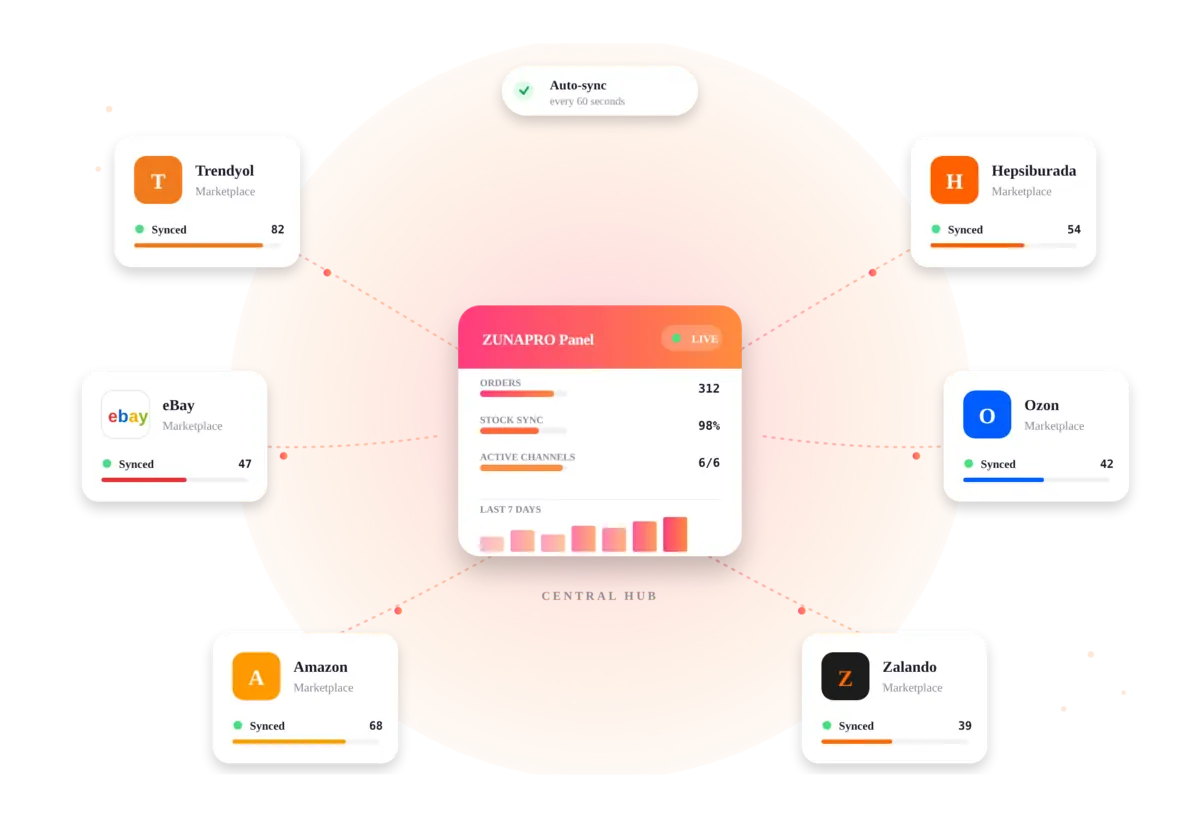
Integrated with the leading marketplaces in China
…and many more — we work with every marketplace that offers integration support.
Smart Automation
A SKU sold on Tmall Global drops stock on JD.com and Pinduoduo within seconds. SF Express, JD Logistics and Cainiao labels print from one screen, and e-Fapiao (数电发票) records carrying 13% VAT are issued and archived automatically — clean books from day one.
Profit Optimization
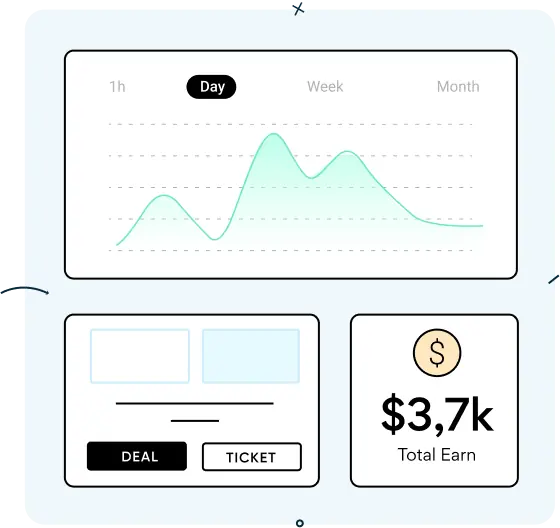
Tmall Global takes roughly 2-5% plus an annual fee, JD Worldwide 2-8%, Douyin 2-5%. The repricer reads Alipay, WeChat Pay and UnionPay settlements, factors in PIPL and Cybersecurity Law obligations, then writes channel-specific CNY prices that protect your WFOE margin.
Flexible plans that grow with you.
To try it out and start growing
For single-marketplace sellers
Most popular for multi-channel sellers
Professional plan for growing volume
Full package for high volume and cross-border
Tailored solution for enterprise needs
Pay monthly · Free setup · Cancel anytime
Manage all marketplace operations from one panel.

Marketplace orders flow into your panel automatically; tracking codes flow back.

Stock updates on every marketplace at the same time. Overselling risk eliminated.

Compute prices automatically based on each marketplace's commission.

Upload thousands of products to every marketplace via Excel or XML.

Print labels for every marketplace in one click.

Live revenue, profit, returns and review reports per marketplace.
Local marketplaces, carriers, payment methods and compliance frameworks — from a single panel
Tmall Global is a cross-border channel, so no mainland entity is required — an offshore company (Hong Kong works well) plus brand authorization is enough to apply. Onboarding usually runs through a certified TP (Tmall Partner) agency, with a security deposit of roughly USD 25,000 plus an annual fee. Expect 4-8 weeks from application to store launch, with brand credentials and overseas sales history weighing heavily.
JD Worldwide is also open to overseas entities: you need a foreign-registered company, trademark proof and cross-border qualifications — no WFOE required. Commission runs about 2-8% by category plus a platform fee. Goods can flow through JD Logistics bonded warehouses or direct international mail, with tracking numbers posting back to the panel automatically.
A domestic Douyin shop requires a Chinese business licence; overseas sellers enter via Douyin's cross-border programme or a licensed local partner. Category deposits range from a few thousand to tens of thousands of RMB, and commission sits around 2-5%. Once live, livestream and short-video orders land in the same panel as every other channel, drawing from one shared stock pool.
Tmall Global charges roughly 2-5% by category plus an Alipay fee of about 1%, JD Worldwide 2-8%, Douyin 2-5%, while Pinduoduo's base commission is minimal with costs shifting to promotions. The pricing engine folds these rates and amortized deposits into channel-specific CNY prices that protect your margin.
In pilot zones like Hangzhou and Zhengzhou, you ship inventory in bulk into a bonded warehouse (model 1210); when a consumer orders, the parcel clears customs under the cross-border e-commerce composite tax (from about 9.1%) and ships domestically — delivery speed close to local e-commerce. Direct mail (model 9610) is the alternative. The system generates the required three-document customs data per order.
Shoppers pay via Alipay, WeChat Pay or UnionPay; funds sit in the platform's escrow and settle on a 7-21 day cycle. Cross-border stores convert RMB to USD or EUR through licensed cross-border payment providers. The panel reconciles every settlement against its orders and e-Fapiao records, so FX slippage is visible at a glance.
CCC (China Compulsory Certification) covers catalogued goods such as electronics, electrical appliances and toys, and is mandatory for general-trade imports. Products sold under the CBEC bonded or direct-mail model, cleared as personal-use parcels, are usually exempt from CCC — though quality and labelling rules still apply. The panel flags required certificates per category before listing.
China is the world's largest e-commerce market: more than 900 million online shoppers and close to half of global online retail GMV flow through an ecosystem that looks nothing like the Amazon-centric West. For a foreign brand the realistic entry is a portfolio — Tmall Global through a certified TP partner, JD Worldwide on bonded logistics, Douyin for livestream demand, Xiaohongshu for discovery — all wrapped in the CBEC customs model that keeps you out of general-trade import bureaucracy. This playbook breaks down commissions, deposits, the 1210/9610 customs routes, RMB collection and the compliance items (CCC, e-Fapiao, PIPL) you must clear before the first order ships.
There is no single dominant "everything store". The Alibaba ecosystem (Tmall, Tmall Global, Taobao) still owns the largest share of branded retail; JD.com dominates electronics and appliances with its own nationwide logistics; Pinduoduo wins on value-driven, group-buying demand in lower-tier cities; Douyin has turned short video and livestreams into a full-scale "interest e-commerce" channel; Xiaohongshu is where urban consumers research and discover brands; Kaola remains a dedicated cross-border import platform inside the Alibaba group.
Successful entrants treat these as complementary layers, not competitors: Tmall Global as the flagship trust anchor, JD Worldwide for logistics-sensitive categories, Douyin for demand generation, Xiaohongshu for community proof. Locking into a single channel is the most common reason cross-border sellers stall — and manually reconciling four channels is the second.
Headline commissions in China are lower than Western marketplaces, but deposits, annual fees and payment processing shift the real cost structure. Below is the 2026 reference table we use when modelling unit economics for the Chinese market.
| Platform | Commission | Deposit | Entry Model | Payout |
|---|---|---|---|---|
| Tmall Global | 2-5% + ~1% Alipay | ~USD 25,000 + annual fee | Offshore entity via TP partner | 7-21 days |
| JD Worldwide | 2-8% + platform fee | Category-based | Foreign entity, no WFOE | 7-21 days |
| Douyin Shop | 2-5% | Thousands to tens of thousands RMB | Cross-border programme or licensed partner | 7-21 days |
| Pinduoduo | Minimal base; promo-driven | Low | Domestic or cross-border | Cycle-based |
| Taobao | Low base | Low | Chinese business licence | Fast |
| Xiaohongshu | Category-based | Category-based | Cross-border friendly | Cycle-based |
Tmall Global is a cross-border channel, so you do not need a mainland Chinese company — an offshore entity (Hong Kong is the common choice) plus brand authorization is enough to apply. In practice, onboarding runs through a certified TP (Tmall Partner) agency that prepares the application, manages the store and handles platform communication. Budget a security deposit of roughly USD 25,000 plus an annual fee, and expect 4-8 weeks from application to store launch.
Approval weighs brand credentials heavily: trademark registrations, overseas sales history and category fit matter more than catalogue size. Once live, Tmall Global functions as your trust anchor with Chinese consumers.
JD Worldwide is also open to overseas entities: a foreign-registered company, trademark proof and cross-border qualifications are sufficient — no WFOE required. Commission runs 2-8% by category plus a platform fee. JD's differentiator is logistics: goods flow through JD Logistics bonded warehouses or direct international mail, and JD's delivery speed is itself a conversion driver in electronics, appliances, mother-and-baby and health categories.
For sellers, that means inventory placement decisions matter as much as pricing. Stocking a Hangzhou or Zhengzhou bonded warehouse puts you at near-domestic delivery speed; direct mail keeps capital light but delivers in 7-15 days.
Douyin (TikTok's Chinese sibling) built "interest e-commerce": consumers don't search for products, products find them mid-scroll. A domestic Douyin shop requires a Chinese business licence; overseas sellers enter via Douyin's cross-border programme or a licensed local partner. Category deposits range from a few thousand to tens of thousands of RMB and commission sits around 2-5%.
The operational reality is spiky demand: a single successful livestream can sell a week's inventory in twenty minutes. Livestream and short-video orders must land in the same panel as everything else, decrementing one shared stock figure in seconds.
Xiaohongshu (RED) is where China's urban consumers research before buying — part Instagram, part review platform, increasingly a closed-loop store. It is cross-border friendly and rewards authentic content seeding via KOL and KOC creators far more than ad spend. For premium and beauty brands, a Xiaohongshu presence often precedes and de-risks the Tmall Global investment.
Taobao remains the long-tail engine but requires a Chinese business licence, making it a later-stage channel for foreign sellers. Kaola, NetEase's former import platform now inside Alibaba, retains a loyal cross-border shopper base and is worth listing on once your Tmall Global operation is stable.
China's cross-border e-commerce (CBEC) regime is what makes all of this workable without a Chinese import licence. Under model 1210, you ship inventory in bulk into a bonded warehouse in a pilot zone such as Hangzhou or Zhengzhou; when a consumer orders, the parcel clears customs under the cross-border e-commerce composite tax — from roughly 9.1% for standard-VAT goods — and ships domestically. Model 9610 is the direct-mail alternative: parcels fly individually from your origin warehouse and clear on arrival.
Every CBEC order requires the "three documents" — order, payment and logistics data — filed electronically with customs, matched per parcel. Personal-use limits apply per buyer (per-order and annual caps), and goods must be on the CBEC positive list.
Shoppers pay with Alipay, WeChat Pay or UnionPay; funds sit in the platform's escrow account and settle to you on a 7-21 day cycle. Cross-border stores then convert RMB to USD or EUR through licensed cross-border payment providers and remit abroad. Each step — escrow, settlement, conversion, remittance — has its own timing and fee, and FX slippage of 1-2% is common if unmanaged.
The discipline that protects margin is reconciliation: every settlement matched against its orders and e-Fapiao records, every FX conversion logged against the rate of the day.
CCC (China Compulsory Certification) covers catalogued goods such as electronics, electrical appliances and toys, and is mandatory for general-trade imports. Products sold under the CBEC bonded or direct-mail model, cleared as personal-use parcels, are usually exempt from CCC — though quality and labelling rules still apply, and category rules should be checked before listing.
On the fiscal side, China's fully digital e-Fapiao (数电发票) regime carries the standard 13% VAT rate, and invoices must be issued and archived per order. Data compliance adds PIPL (China's GDPR equivalent) and the Cybersecurity Law: customer data of Chinese consumers is subject to localisation and transfer rules that your systems architecture must respect from day one.
Running four Chinese channels manually means four seller centrals, four stock spreadsheets, four settlement reports in RMB — and a livestream spike on Douyin quietly overselling your Tmall Global stock. ZunaPro connects Tmall Global, JD.com, Pinduoduo and Douyin (with Taobao and Xiaohongshu covered too) in one panel: a SKU sold on any channel decrements the shared stock pool within seconds.
SF Express, JD Logistics and Cainiao labels print from one screen; e-Fapiao records with 13% VAT are issued and archived automatically; the three-document CBEC customs data is generated per order. The repricer reads Alipay, WeChat Pay and UnionPay settlements, folds in commissions and amortized deposits, and writes channel-specific CNY prices that protect your margin — whether you operate through a Hong Kong entity or a WFOE in Shanghai or Shenzhen.
Our experts map out your path in marketplace integration, e-commerce and company formation — free, no obligation.
Get Free Consultation →