Local Marketplaces
- Bol.com
- Amazon.nl
- Marktplaats
- Coolblue
- Wehkamp
- Beslist.nl
- Blokker
- fonQ
- Zalando
- VidaXL
- Etsy
- eBay
- Temu


From an Amsterdam Zuid notaris to a Rotterdam tandarts — AVG-ready corporate websites in sober Dutch style and ranked locally on Google.
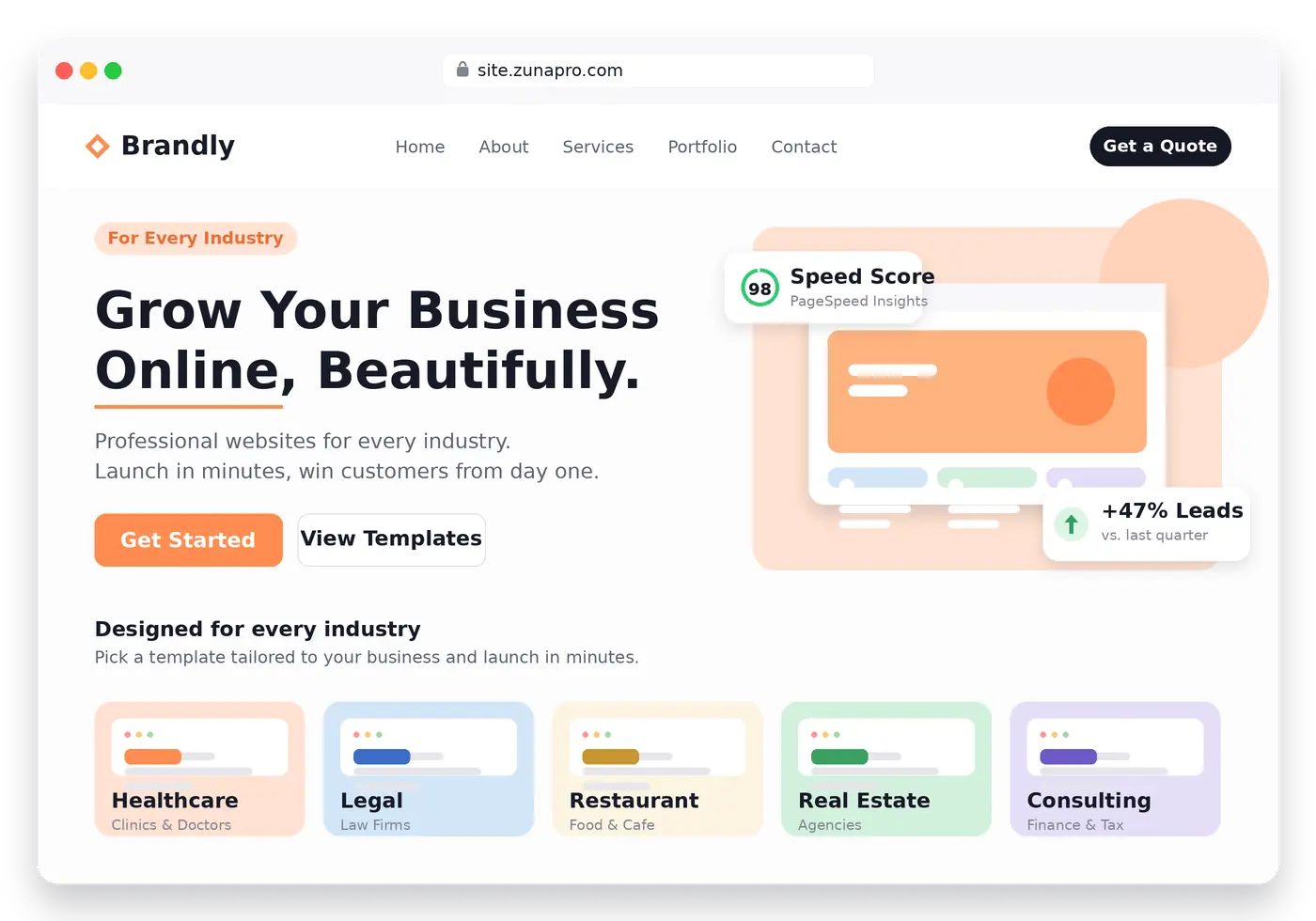
Every profession has different web needs. A vet site differs from a lawyer site in structure, content and booking flow. Work with someone who knows your industry.
Booking form, services, team intro
Explore →Treatment pages, before/after, prices
Explore →Pet records, vaccine schedule, contact
Explore →Practice areas, references, intake form
Explore →Service plans, client portal, live chat
Explore →Menu, reservations, location, ordering
Explore →Project portfolio, team, quote form
Explore →Room photos, booking integration
Explore →Service list, online booking, offers
Explore →Listings, service booking, price list
Explore →Catalog, on-call info, online form
Explore →Listings, virtual tour, valuation form
Explore →
A Utrecht B.V. accountancy needs a KvK number in the footer and an AP-compliant contact form; a Den Haag dentist needs an online booking module with a visible BIG-registratie. We design around these sector reflexes, never a stock template.
We deliver and stick around. AVG/AP cookie banner, iDEAL and Mollie for deposits, PostNL track-and-trace in confirmation emails and a monthly Search Console report covering Amsterdam, Rotterdam and Eindhoven queries.
Hosting, SSL, speed optimization, SEO foundation and technical maintenance — all in one plan.
Google-loved speed scores. Auto sitemap, schema.org and meta tags.
Perfect on every device. 70% of your customers visit on mobile.

Booking, quote and contact forms — WhatsApp and email notifications.

Free SSL certificate, DDoS protection and regular backups included.

No-code panel. Update text, photos and prices yourself.

Google Maps, Instagram feed and social share buttons.
Local marketplaces, carriers, payment methods and compliance frameworks — from a single panel
All plans are annual. Hosting, SSL, maintenance and support included.
For new and small businesses
For growing multi-page sites
For fully custom design and integrations
Annual billing · Free setup · Hosting & SSL included
For a Dutch B.V. or Eenmanszaak we deliver services, team, references and contact pages in a CMS panel you can edit yourself. Dutch is the default, with English and Turkish available on request. Prices display in EUR, and where needed we separate out the 21% BTW so your figures stay correct for Dutch customers.
Your footer must carry the KvK number and contact details, and you need a privacyverklaring under the AVG (the Dutch GDPR) plus a cookie consent banner aligned with AP (Autoriteit Persoonsgegevens) guidance. We write these in Dutch, pin them to the footer and technically guarantee that no analytics or marketing cookie loads before the visitor has given consent.
We set hreflang tags for nl and en, and build city-targeted landing pages and local keywords for Amsterdam, Rotterdam, Den Haag, Utrecht and Eindhoven. We create and verify your Google Business Profile, enforce NAP consistency and track rankings in those cities through a monthly Google Search Console report.
We register your .nl domain, host inside the EU and set up [email protected] business email. The site is tuned to pass Core Web Vitals (LCP, INP, CLS) thresholds; to respect the AVG we keep data on EU-based infrastructure and include SSL and daily backups as standard.
A corporate site typically goes live in 2-4 weeks, quoted clearly in EUR with the 21% BTW separated out where required. We don't build and disappear: our maintenance plan covers AVG-related updates, content changes and the monthly Search Console report so your site stays compliant and visible.
We build AP-compliant contact and online booking forms, load analytics only after consent, and where deposits are needed integrate iDEAL via Mollie or Stripe. We add PostNL or DHL Parcel tracking links to confirmation emails and publish the interface bilingually in Dutch and English.
A professional website in the Netherlands is no longer a digital business card — it is a regulated, multilingual, conversion-optimised tool that has to satisfy the KvK transparency rules, the AVG (Dutch GDPR) and the customer expectations of one of the world's most digitally fluent populations. This guide explains how to design, build and deploy websites for the most common Dutch service sectors: notaries, lawyers, dentists, general practitioners, accountants and restaurants — plus the cross-cutting requirements around bilingual content, cookie consent and Core Web Vitals.
In the Netherlands, the Notaris (civil-law notary) plays a central role in B.V. incorporation, real estate transfer and inheritance. Notary websites typically host appointment booking, fee transparency (mandated by the KNB — Koninklijke Notariële Beroepsorganisatie), document checklists, fee calculators and a client portal. Law firms (Advocatenkantoren) follow the NOvA (Nederlandse Orde van Advocaten) ethical code: marketing copy must stay measured and factual, not boastful.
Dentists and general practitioners (huisartsen) need to display partner insurers (Zilveren Kruis, CZ, VGZ, Menzis), online booking, treatment information and KNMT/BIG-register certifications. The BIG-register is the public Dutch healthcare professional registry. Health data falls under AVG's "special category" and requires elevated protection: encrypted at rest, EU-hosted, with explicit consent for any third-party processor.
| Profession | Typical Module | Regulator / Cert |
|---|---|---|
| Notaris | Fees, booking, portal | KNB, KvK |
| Advocaat | Practice areas, blog, booking | NOvA, BAR No. |
| Tandarts | Insurance, online booking | KNMT, BIG-register |
| Accountant | Client portal, blog, BTW guide | NBA, AFM |
| Restaurant | Menu, reservation, map | KHN, HACCP |
Amsterdam, Rotterdam and Utrecht host one of Europe's most competitive restaurant scenes. A restaurant website needs a clean menu (PDF + dynamic HTML), reservations through Resengo, TheFork or Eveve, online order via Thuisbezorgd.nl, Uber Eats and Deliveroo, and a polished Google Business Profile. KHN (Koninklijke Horeca Nederland) membership and HACCP certification build trust and should appear visibly.
Dutch accounting firms typically expose a client portal connected to Exact Online, Twinfield or AFAS, with NBA (Nederlandse Beroepsorganisatie van Accountants) membership badge and AFM supervision disclosure. Clients expect to submit receipts, view BTW returns and access the annual report (jaarrekening) through a single login. eHerkenning integration makes filing with Belastingdienst trivial and is a strong differentiator versus competitors that still require document email exchange.
Roughly 85% of Amsterdam adults speak a non-Dutch first language; in Eindhoven Brainport the English-speaking workforce is dominant. Professional service websites should ship NL + EN simultaneously. Technically, Next.js i18n, Nuxt i18n or WordPress Polylang/WPML solve this cleanly. URL structure uses /nl/ and /en/ segments with hreflang tags pointing at language equivalents.
Every Dutch corporate website must show the KvK number, BTW-id and physical address in the footer (the "Mijn Bedrijf" disclosure principle). Under AVG you need a Privacyverklaring, a Cookiebeleid and — for any third-party processor — a Verwerkersovereenkomst (data processing agreement). The Autoriteit Persoonsgegevens (AP) actively monitors compliance and has fined SMEs for misleading cookie banners.
The Netherlands has one of the fastest residential broadband averages in the EU (200+ Mbps fibre via KPN, Ziggo, Odido and Delta). High user expectations mean LCP < 2.5s, INP < 200ms and CLS < 0.1 are minimum thresholds for ranking on Google.nl. Hosting in Amsterdam (AMS-IX), Frankfurt or Eemshaven via Vercel, Cloudflare or TransIP keeps latency below 30ms for Dutch visitors.
For local practitioners and restaurants, Google Business Profile (Google Mijn Bedrijf) is non-negotiable. Reviews, hours, photos and service list must be kept current. Dutch search behaviour relies on patterns like "in de buurt" (nearby) and "bij mij" (near me); your content should mirror these queries. NAP (Name, Address, Phone) must match the KvK registration exactly — discrepancies suppress rankings.
WordPress still holds roughly half of the Dutch corporate website market; Webflow and Framer are growing fast; and Next.js with a headless CMS (Sanity, Storyblok, Contentful) has become the default for tech-forward firms. Decision criteria revolve around multi-language management, AVG-friendly forms (Gravity Forms, HubSpot, Mailchimp NL) and integrated booking widgets such as Cal.com (self-hosted) or Calendly.
| CMS | Monthly | Multi-language | AVG Form |
|---|---|---|---|
| WordPress | €15-50 | Polylang / WPML | Gravity Forms |
| Webflow | €29-49 | Native localize | Native |
| Framer | €20-40 | Locale switch | Form CMS |
| Next.js + Sanity | €10-25 hosting | i18n routing | Custom DPA |
| Squarespace | €18-40 | Limited | Native |
The Netherlands enforces an Accessibility Declaration (Toegankelijkheidsverklaring) on public-sector websites. Private companies are not formally bound by it, but WCAG 2.1 AA has become the standard expectation in B2B procurement. Colour contrast, alt text, keyboard navigation and screen-reader support are core deliverables. Aim for a Lighthouse Accessibility score above 90; this also benefits SEO indirectly through better semantic HTML.
A Dutch corporate website is not a one-off deliverable — it needs continuous care. Monthly maintenance retainers run €75-150 on WordPress (updates, backups, malware scans). SSL is free with Let's Encrypt, or €30-80/year for an OV/EV certificate. Under AVG, every form, cookie and analytics tool should be re-audited at least annually; AP enquiries must be answered within 72 hours. Visual refreshes typically come every three years, or sooner when a new service line, repositioning or major regulation change triggers the work.
A successful Dutch corporate website rests on four foundations: the right CMS (WordPress, Webflow, Framer or Next.js+Sanity), bilingual NL+EN content with hreflang tagging, AVG-compliant cookie and form handling, and sector-specific modules (booking for healthcare and legal, reservations and order-in for hospitality, client portals for accounting). Only after these basics do SEO, Google Business Profile, Core Web Vitals and ongoing maintenance enter the discussion. A healthy schedule: weeks 1-2 discovery and wireframes, 3-5 design, 6-9 development, 10-11 content and AVG audit, 12 launch and measurement. Invest most carefully in the first two phases — a well-scoped site costs roughly half as much to build and a third as much to maintain as one that improvises.
Our experts map out your path in marketplace integration, e-commerce and company formation — free, no obligation.
Get Free Consultation →