Местные маркетплейсы
- Tmall Global
- JD Worldwide
- Pinduoduo
- Douyin
- Taobao
- Xiaohongshu
- Vipshop
- WeChat Channels


Tmall Global, JD.com, Pinduoduo и Douyin в одной панели — заказы, остатки и цены в CNY синхронизируются автоматически из вашего офиса в Шанхае или Шэньчжэне; Taobao и Xiaohongshu тоже поддерживаются.
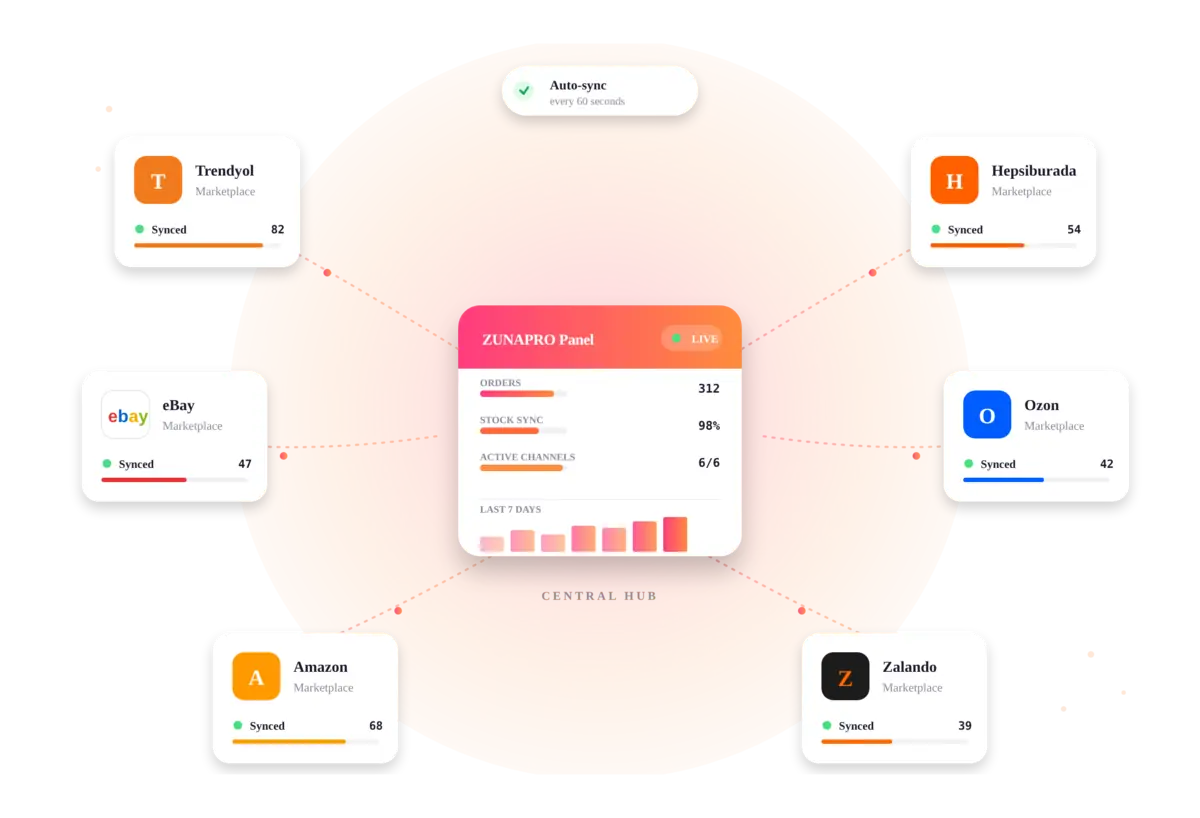
Интеграция с ведущими маркетплейсами страны: Китай
…и многие другие — мы работаем со всеми маркетплейсами, которые поддерживают интеграцию.
Умная автоматизация
SKU, проданный на Tmall Global, за секунды списывается с остатков на JD.com и Pinduoduo. Этикетки SF Express, JD Logistics и Cainiao печатаются с одного экрана, а записи заказов с НДС 13% автоматически архивируются и экспортируются для выставления e-Fapiao (数电发票) — чистый учёт с первого дня.
Оптимизация прибыли
Каждый маркетплейс устанавливает собственные комиссии и сборы в зависимости от категории. Репрайсер считывает поступления от Alipay, WeChat Pay и UnionPay, учитывает обязательства по PIPL и Закону о кибербезопасности, а затем формирует цены в CNY для каждого канала, которые защищают маржу вашей WFOE.
Гибкие тарифы, которые растут вместе с вами.
Чтобы попробовать и начать расти
Для продавцов на одном маркетплейсе
Самый популярный для многоканальных продавцов
Профессиональный тариф для растущих объёмов
Полный пакет для больших объёмов и трансграничных продаж
Индивидуальное решение для крупного бизнеса
Ежемесячная оплата · Бесплатная настройка · Отмена в любой момент
Оплата производится в турецких лирах (TRY); точная сумма отображается при оплате.
Управляйте всеми процессами на маркетплейсах из одной панели.

Заказы с маркетплейсов автоматически поступают в вашу панель, а трек-номера возвращаются обратно.

Остатки обновляются на всех маркетплейсах одновременно. Риск продаж сверх остатков исключён.

Цены рассчитываются автоматически с учётом комиссии каждого маркетплейса.

Загружайте тысячи товаров на все маркетплейсы через Excel или XML.

Печать этикеток для всех маркетплейсов в один клик.

Отчёты о выручке, прибыли, возвратах и отзывах по каждому маркетплейсу в реальном времени.
Местные маркетплейсы, службы доставки, способы оплаты и требования законодательства — в одной панели
В Китае электронная коммерция происходит в основном внутри платформ: Taobao и Tmall, JD.com, Pinduoduo, а также каналы контент-коммерции — Douyin, Kuaishou и Xiaohongshu. Иностранные бренды обычно заходят на Tmall Global или JD Worldwide как трансграничные продавцы, часто через местного сервисного партнёра, и должны обеспечивать семидневный возврат без объяснения причин и карточки товаров на китайском.
С 1 января 2026 года НДС регулируется новым Законом об НДС; ставки 13 %, 9 % и 6 % не изменились. Товары, купленные через канал трансграничного розничного импорта (CBEC), облагаются отдельной комплексной ставкой.
Данные проверены: · Общая информация, не юридическая и не налоговая консультация.
Заполните форму — наши специалисты ответят в течение 24 часов с индивидуальным предложением. Без обязательств.
Tmall Global — трансграничный канал, поэтому юрлицо в материковом Китае не требуется: для подачи заявки достаточно офшорной компании (хорошо подходит Гонконг) и авторизации бренда. Подключение обычно проходит через сертифицированное агентство TP (Tmall Partner); гарантийный депозит составляет примерно 25 000 USD плюс годовой сбор. От заявки до запуска магазина проходит 4–8 недель, при этом большое значение имеют репутация бренда и история продаж за рубежом.
JD Worldwide также открыт для зарубежных компаний: нужны компания, зарегистрированная за рубежом, подтверждение прав на товарный знак и допуск к трансграничной торговле — WFOE не требуется. Комиссия зависит от категории, плюс плата за платформу. Товары могут поступать через бондовые склады JD Logistics или международной прямой почтой, а трек-номера автоматически передаются в панель.
Для внутреннего магазина в Douyin нужна китайская бизнес-лицензия; зарубежные продавцы заходят через трансграничную программу Douyin или через лицензированного местного партнёра. Депозиты по категориям составляют от нескольких тысяч до десятков тысяч юаней (RMB), а комиссия зависит от категории. После запуска заказы из прямых эфиров и коротких видео поступают в ту же панель, что и заказы из всех остальных каналов, и списываются из единого пула остатков.
Каждый маркетплейс устанавливает собственные комиссии и сборы в зависимости от категории. Ценовой движок закладывает эти ставки и амортизацию депозитов в цены в CNY для каждого канала, защищая вашу маржу.
В пилотных зонах, таких как Ханчжоу и Чжэнчжоу, вы ввозите товарные запасы партией на бондовый склад (модель 1210); когда покупатель оформляет заказ, посылка проходит таможенную очистку по сводному налогу для трансграничной электронной торговли (от примерно 9,1%) и доставляется внутри страны — со скоростью, близкой к обычной внутренней электронной торговле. Альтернатива — прямая почтовая отправка (модель 9610). Система формирует обязательный для таможни комплект данных из трёх документов по каждому заказу.
Покупатели платят через Alipay, WeChat Pay или UnionPay; средства находятся на эскроу-счёте платформы и выплачиваются по циклу 7–21 день. Трансграничные магазины конвертируют юани (RMB) в USD или EUR через лицензированных провайдеров трансграничных платежей. Панель сверяет каждую выплату с соответствующими заказами, поэтому валютные потери видны с первого взгляда.
CCC (China Compulsory Certification — обязательная сертификация Китая) распространяется на товары из перечня, такие как электроника, электроприборы и игрушки, и обязательна для импорта в режиме общей торговли. Товары, продаваемые по модели CBEC через бондовый склад или прямой почтой и оформляемые как посылки для личного пользования, как правило, освобождены от CCC, хотя требования к качеству и маркировке всё равно действуют. Панель ещё до размещения указывает, какие сертификаты нужны для каждой категории.
China is the world's largest e-commerce market: more than 900 million online shoppers and close to half of global online retail GMV flow through an ecosystem that looks nothing like the Amazon-centric West. For a foreign brand the realistic entry is a portfolio — Tmall Global through a certified TP partner, JD Worldwide on bonded logistics, Douyin for livestream demand, Xiaohongshu for discovery — all wrapped in the CBEC customs model that keeps you out of general-trade import bureaucracy. This playbook breaks down commissions, deposits, the 1210/9610 customs routes, RMB collection and the compliance items (CCC, e-Fapiao, PIPL) you must clear before the first order ships.
There is no single dominant "everything store". The Alibaba ecosystem (Tmall, Tmall Global, Taobao) still owns the largest share of branded retail; JD.com dominates electronics and appliances with its own nationwide logistics; Pinduoduo wins on value-driven, group-buying demand in lower-tier cities; Douyin has turned short video and livestreams into a full-scale "interest e-commerce" channel; Xiaohongshu is where urban consumers research and discover brands; Kaola remains a dedicated cross-border import platform inside the Alibaba group.
Successful entrants treat these as complementary layers, not competitors: Tmall Global as the flagship trust anchor, JD Worldwide for logistics-sensitive categories, Douyin for demand generation, Xiaohongshu for community proof. Locking into a single channel is the most common reason cross-border sellers stall — and manually reconciling four channels is the second.
Headline commissions in China are lower than Western marketplaces, but deposits, annual fees and payment processing shift the real cost structure. Below is the 2026 reference table we use when modelling unit economics for the Chinese market.
| Platform | Commission | Deposit | Entry Model | Payout |
|---|---|---|---|---|
| Tmall Global | 2-5% + ~1% Alipay | ~USD 25,000 + annual fee | Offshore entity via TP partner | 7-21 days |
| JD Worldwide | 2-8% + platform fee | Category-based | Foreign entity, no WFOE | 7-21 days |
| Douyin Shop | 2-5% | Thousands to tens of thousands RMB | Cross-border programme or licensed partner | 7-21 days |
| Pinduoduo | Minimal base; promo-driven | Low | Domestic or cross-border | Cycle-based |
| Taobao | Low base | Low | Chinese business licence | Fast |
| Xiaohongshu | Category-based | Category-based | Cross-border friendly | Cycle-based |
Tmall Global is a cross-border channel, so you do not need a mainland Chinese company — an offshore entity (Hong Kong is the common choice) plus brand authorization is enough to apply. In practice, onboarding runs through a certified TP (Tmall Partner) agency that prepares the application, manages the store and handles platform communication. Budget a security deposit of roughly USD 25,000 plus an annual fee, and expect 4-8 weeks from application to store launch.
Approval weighs brand credentials heavily: trademark registrations, overseas sales history and category fit matter more than catalogue size. Once live, Tmall Global functions as your trust anchor with Chinese consumers.
JD Worldwide is also open to overseas entities: a foreign-registered company, trademark proof and cross-border qualifications are sufficient — no WFOE required. Commission runs 2-8% by category plus a platform fee. JD's differentiator is logistics: goods flow through JD Logistics bonded warehouses or direct international mail, and JD's delivery speed is itself a conversion driver in electronics, appliances, mother-and-baby and health categories.
For sellers, that means inventory placement decisions matter as much as pricing. Stocking a Hangzhou or Zhengzhou bonded warehouse puts you at near-domestic delivery speed; direct mail keeps capital light but delivers in 7-15 days.
Douyin (TikTok's Chinese sibling) built "interest e-commerce": consumers don't search for products, products find them mid-scroll. A domestic Douyin shop requires a Chinese business licence; overseas sellers enter via Douyin's cross-border programme or a licensed local partner. Category deposits range from a few thousand to tens of thousands of RMB and commission sits around 2-5%.
The operational reality is spiky demand: a single successful livestream can sell a week's inventory in twenty minutes. Livestream and short-video orders must land in the same panel as everything else, decrementing one shared stock figure in seconds.
Xiaohongshu (RED) is where China's urban consumers research before buying — part Instagram, part review platform, increasingly a closed-loop store. It is cross-border friendly and rewards authentic content seeding via KOL and KOC creators far more than ad spend. For premium and beauty brands, a Xiaohongshu presence often precedes and de-risks the Tmall Global investment.
Taobao remains the long-tail engine but requires a Chinese business licence, making it a later-stage channel for foreign sellers. Kaola, NetEase's former import platform now inside Alibaba, retains a loyal cross-border shopper base and is worth listing on once your Tmall Global operation is stable.
China's cross-border e-commerce (CBEC) regime is what makes all of this workable without a Chinese import licence. Under model 1210, you ship inventory in bulk into a bonded warehouse in a pilot zone such as Hangzhou or Zhengzhou; when a consumer orders, the parcel clears customs under the cross-border e-commerce composite tax — from roughly 9.1% for standard-VAT goods — and ships domestically. Model 9610 is the direct-mail alternative: parcels fly individually from your origin warehouse and clear on arrival.
Every CBEC order requires the "three documents" — order, payment and logistics data — filed electronically with customs, matched per parcel. Personal-use limits apply per buyer (per-order and annual caps), and goods must be on the CBEC positive list.
Shoppers pay with Alipay, WeChat Pay or UnionPay; funds sit in the platform's escrow account and settle to you on a 7-21 day cycle. Cross-border stores then convert RMB to USD or EUR through licensed cross-border payment providers and remit abroad. Each step — escrow, settlement, conversion, remittance — has its own timing and fee, and FX slippage of 1-2% is common if unmanaged.
The discipline that protects margin is reconciliation: every settlement matched against its orders and e-Fapiao records, every FX conversion logged against the rate of the day.
CCC (China Compulsory Certification) covers catalogued goods such as electronics, electrical appliances and toys, and is mandatory for general-trade imports. Products sold under the CBEC bonded or direct-mail model, cleared as personal-use parcels, are usually exempt from CCC — though quality and labelling rules still apply, and category rules should be checked before listing.
On the fiscal side, China's fully digital e-Fapiao (数电发票) regime carries the standard 13% VAT rate, and invoices must be issued and archived per order. Data compliance adds PIPL (China's GDPR equivalent) and the Cybersecurity Law: customer data of Chinese consumers is subject to localisation and transfer rules that your systems architecture must respect from day one.
Running four Chinese channels manually means four seller centrals, four stock spreadsheets, four settlement reports in RMB — and a livestream spike on Douyin quietly overselling your Tmall Global stock. ZunaPro connects Tmall Global, JD.com, Pinduoduo and Douyin (with Taobao and Xiaohongshu covered too) in one panel: a SKU sold on any channel decrements the shared stock pool within seconds.
SF Express, JD Logistics and Cainiao labels print from one screen; e-Fapiao records with 13% VAT are issued and archived automatically; the three-document CBEC customs data is generated per order. The repricer reads Alipay, WeChat Pay and UnionPay settlements, folds in commissions and amortized deposits, and writes channel-specific CNY prices that protect your margin — whether you operate through a Hong Kong entity or a WFOE in Shanghai or Shenzhen.
Our experts map out your path in marketplace integration, e-commerce and company formation — free, no obligation.
Get Free Consultation →