Local Marketplaces
- Amazon.com
- Walmart Marketplace
- eBay
- Etsy
- Target Plus
- TikTok Shop
- Newegg
- Wayfair
- Best Buy Marketplace
- Macy's
- Faire
- Temu


Website design prices start at €990 a year — hosting, SSL, maintenance and support included.
From a Miami dental practice to an Austin law firm — ADA-conscious US corporate websites built to rank on Google with green Core Web Vitals.
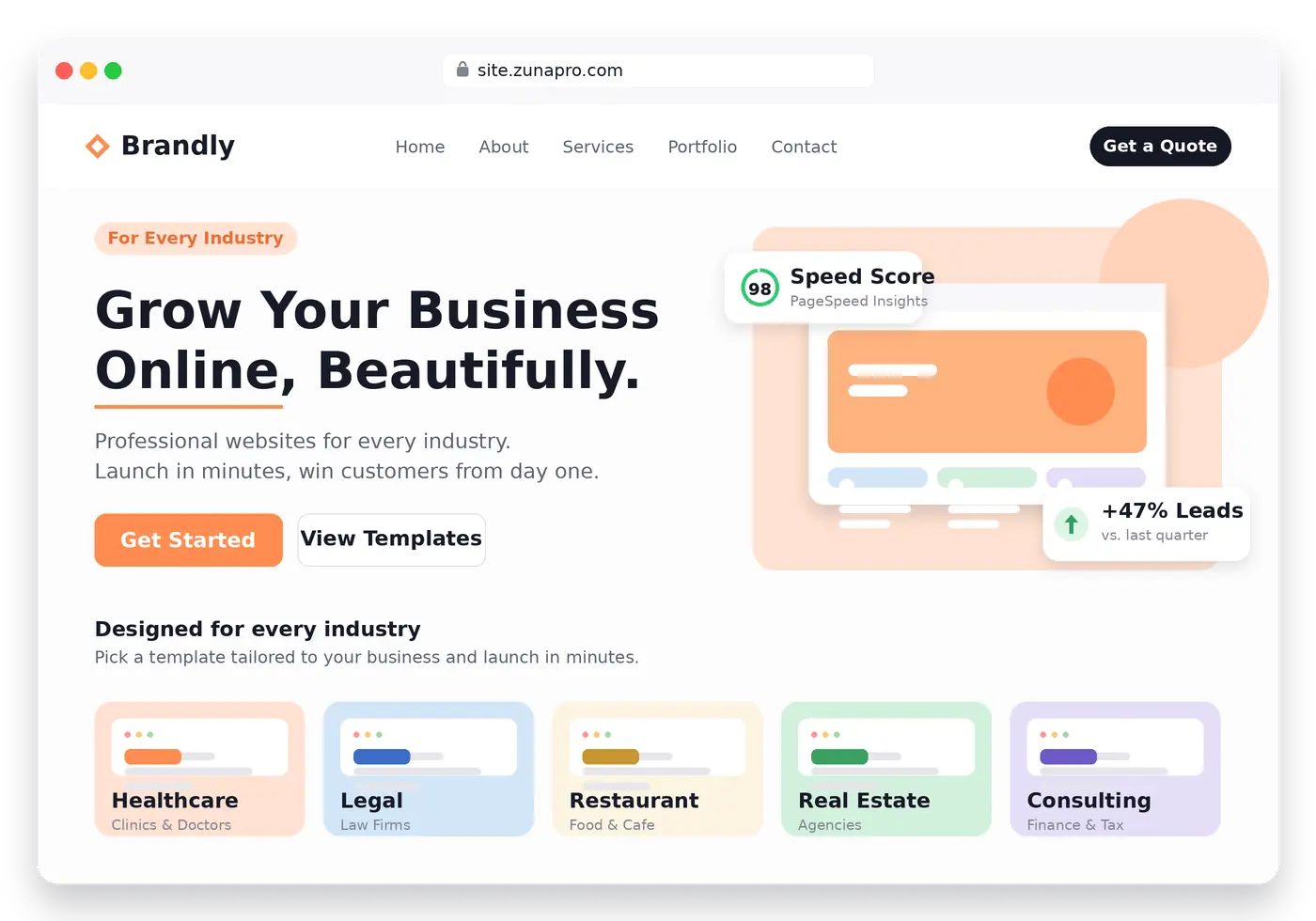
Every profession has different web needs. A vet site differs from a lawyer site in structure, content and booking flow. Work with someone who knows your industry.
Booking form, services, team intro
Explore →Treatment pages, before/after, prices
Explore →Pet records, vaccine schedule, contact
Explore →Practice areas, references, intake form
Explore →Service plans, client portal, live chat
Explore →Menu, reservations, location, ordering
Explore →Project portfolio, team, quote form
Explore →Room photos, booking integration
Explore →Service list, online booking, offers
Explore →Listings, service booking, price list
Explore →Catalog, on-call info, online form
Explore →Listings, virtual tour, valuation form
Explore →
A Delaware LLC consultancy needs a CCPA/CPRA "Do Not Sell or Share" notice and WCAG 2.1 AA accessibility — ADA website lawsuits hit thousands of US small businesses every year; a Houston restaurant needs online reservations and a verified Google Business Profile. We design around these US reflexes, never a stock theme.
We deliver and maintain. A nationwide CDN keeps loads fast from New York to Los Angeles, Core Web Vitals stay in Google's green zone, Stripe and PayPal handle deposits, the CCPA cookie banner is kept current as state privacy laws evolve, and a monthly Search Console report tracks your city and multi-state queries.
Hosting, SSL, speed optimization, SEO foundation and technical maintenance — all in one plan.

Google-loved speed scores. Auto sitemap, schema.org and meta tags.

Perfect on every device. 70% of your customers visit on mobile.

Booking, quote and contact forms — WhatsApp and email notifications.

Free SSL certificate, DDoS protection and regular backups included.

No-code panel. Update text, photos and prices yourself.

Google Maps, Instagram feed and social share buttons.
Local marketplaces, carriers, payment methods and compliance frameworks — from a single panel
All plans are annual. Hosting, SSL, maintenance and support included.
For new and small businesses
For growing multi-page sites
For fully custom design and integrations
Annual billing · Free setup · Hosting & SSL included
Zunapro's website design prices are annual and come in three packages: Starter €990, Corporate €2,790 and Premium €4,900 per year, VAT included. Every package includes hosting, an SSL certificate, a mobile-friendly design, basic SEO, maintenance and technical support; setup is free and there are no monthly add-on fees. Small businesses usually choose Starter, multi-page company sites Corporate.
US courts treat business websites as places of public accommodation, and thousands of ADA website lawsuits and demand letters hit small businesses every year — settlements routinely run into five figures. We build to WCAG 2.1 AA: keyboard navigation, alt text, sufficient contrast and screen-reader-tested forms. That protects you legally and improves usability and SEO at the same time.
Yes — there is no legal requirement to have an LLC or corporation before publishing a site; you can start as a sole proprietor. Most clients still form a Delaware or Wyoming LLC early so the domain, contracts and Stripe account sit under the company rather than a personal name. If you incorporate later, we simply update the legal pages and ownership records.
We check USPTO trademark records before registering so your name does not collide with an existing mark — rebranding after launch is expensive. We register the .com, still the default expectation for US customers, secure matching social handles where available and set up DNS, SSL and business email. If you plan a trademark filing, the domain and logo usage on the site are prepared to support it.
Yes — for any business serving local customers it is the single highest-impact free listing. We create or claim the profile, complete verification, align name-address-phone (NAP) with your site footer and wire in reviews, hours, photos and booking links. Local pack rankings in your city then feed directly into the site's lead flow.
We build state- and city-level landing pages — say Texas/Houston, Florida/Miami, Illinois/Chicago — each with locally distinct content instead of duplicated boilerplate, and use multi-location or Service Area Business Profiles where appropriate. LocalBusiness schema per location plus a monthly Search Console report broken out by state shows you what each market actually searches.
CCPA/CPRA applies once you cross thresholds like $25M+ revenue or data on 100,000+ California consumers — but smaller businesses adopt the banner anyway, because ad and analytics vendors classify data sharing as a 'sale'. We add a 'Do Not Sell or Share My Personal Information' link, honour Global Privacy Control signals and keep the policy current as more states such as Virginia, Colorado and Texas enforce their own laws.
The site ships on a nationwide CDN so it loads fast from New York to Los Angeles, with Core Web Vitals kept in Google's green zone — a direct ranking factor. A standard corporate site goes live in 2-3 weeks; pricing is quoted in USD, and the monthly plan covers content updates, security patches, Stripe and PayPal payment links and a Search Console report.
In the United States a business website is more than a digital brochure — it is a legal surface that can attract an ADA lawsuit, a local-search asset that decides whether a Miami dental practice or an Austin law firm shows up in the map pack, and a compliance object under a growing patchwork of state privacy laws. This guide covers what actually matters when you build a corporate website for the US market: WCAG 2.1 AA accessibility, the .com-plus-USPTO domain routine, Google Business Profile, multi-state SEO architecture, CCPA/CPRA cookie management and Core Web Vitals.
Title III of the Americans with Disabilities Act bans discrimination in "places of public accommodation", and the Department of Justice along with most federal courts read business websites into that definition. The consequence is a genuine litigation industry: thousands of ADA website lawsuits are filed in federal court every year — New York, Florida and California lead the docket — on top of an uncounted stream of pre-suit demand letters. Serial plaintiffs deliberately pick small and mid-sized businesses because most owners settle fast rather than fund a federal defense.
Once attorney fees, remediation work and the plaintiff’s costs stack up, settlements routinely land in the five figures — far more than building the site accessibly would have cost in the first place. There is no official federal certification, but WCAG 2.1 AA is the de facto standard that courts and DOJ consent decrees reference. Treating accessibility as a launch requirement rather than a retrofit is the cheapest legal insurance a US website owner can buy.
Accessibility is not a plugin or an overlay widget — courts have seen through those. It is a set of concrete engineering decisions made during design and build:
Before launch we test with real screen readers (VoiceOver, NVDA) alongside automated scans, and we re-check after every major content change — accessibility decays as sites grow.
Legally, no. There is no US requirement to form an LLC or corporation before publishing a website; you can operate as a sole proprietor from day one. That said, most of our clients form a Delaware or Wyoming LLC early, so the domain, hosting contracts and the Stripe account sit under the company rather than a personal name — a separation that starts to matter the moment the site takes payments, bookings or signed engagements.
If you incorporate later, the switch is undramatic: we update the legal pages, the entity name in the privacy policy and terms, and the ownership records on the domain and payment accounts. Nothing about the build has to be redone — which means you can validate the market first and settle the corporate structure second.
For American customers .com remains the default expectation — alternative endings read as improvised. Before registering anything we search the USPTO trademark records so your chosen name does not collide with a live mark in your class of goods or services. Rebranding after launch means a new domain, new signage, migrated ad accounts and abandoned review history: an expensive way to learn a name was already taken.
Alongside the domain we secure matching social handles where available and set up DNS, SSL and business email on your own domain. If a trademark filing is on your roadmap, we prepare the site so the way your name and logo appear can serve as specimen evidence in the application.
For any business serving local customers, the map pack above the organic results decides more phone calls than page-one rankings do. We create or claim your Google Business Profile, complete verification, choose precise categories and load hours, photos, service menus and booking links.
Just as important is consistency: the name, address and phone number (NAP) on the profile must match your site footer and your listings across directories, because conflicting data suppresses local rankings. Reviews are wired into the routine — ask for them, respond to them, and let the profile feed leads straight into the site.
A US business rarely competes in "the United States" — it competes in Houston, in Miami, in Chicago. We build state- and city-level landing pages (Texas/Houston, Florida/Miami, Illinois/Chicago) with locally distinct content: local proof, local phone numbers, local FAQs — never duplicated boilerplate with a swapped city name, which Google filters out.
Each location gets its own LocalBusiness schema; service businesses without a storefront run as Service Area Business profiles. A hub-and-spoke internal linking structure ties the pages together, and the monthly Search Console report is broken out by state so you see what each market actually searches for.
California’s CCPA, as amended by the CPRA, applies once you cross thresholds such as $25M+ in annual revenue, personal data of 100,000+ California consumers or households, or half of your revenue coming from selling data. In practice the definition of "selling or sharing" is broad enough that routine advertising and analytics pixels count — which is why many smaller businesses adopt the banner voluntarily.
We add the "Do Not Sell or Share My Personal Information" link, honour the Global Privacy Control (GPC) browser signal that California actively enforces, and keep the policy current as more states switch on their own laws:
| State | Law | In force |
|---|---|---|
| California | CCPA / CPRA | 2020 / 2023 |
| Virginia | VCDPA | 2023 |
| Colorado | CPA | 2023 |
| Connecticut | CTDPA | 2023 |
| Texas | TDPSA | 2024 |
Google’s Core Web Vitals — LCP for loading, INP for interactivity, CLS for visual stability — are a direct ranking input, and US visitors are unforgiving about slow pages. A customer in Los Angeles should not wait on a single server in Virginia: we ship every site behind a nationwide CDN so assets are served from an edge node near the visitor, coast to coast.
Under the hood that means WebP/AVIF images with strict size budgets, aggressive caching and JavaScript trimmed to what the page actually needs. After launch, field data from Search Console and the Chrome UX Report confirms the site stays in the green zone rather than merely passing a one-off lab test.
A Miami dental practice serves a bilingual market, so the site runs in English and Spanish, with online appointment booking and HIPAA-aware contact forms — no patient details flowing over plain email — plus consented before-and-after galleries. An Austin law firm needs practice-area pages, attorney bios with bar admissions and the advertising disclaimers state bar rules require, all feeding a structured intake form.
A Houston restaurant lives or dies on its Google Business Profile: the menu is published as accessible HTML rather than a scanned PDF (which neither Google nor screen readers handle well), reservations are one tap away, and photos are refreshed on a schedule. Three different businesses — three different builds on the same disciplined foundation.
A standard corporate website goes live in two to three weeks. Pricing is quoted in USD, and deposits are handled through Stripe or PayPal. Before launch you receive the full ADA checklist, the CCPA banner configured for your actual data flows, and the Google Business Profile connected to the site.
The monthly plan is where a US site earns its keep: content updates, security patches, the cookie banner adjusted as new state privacy laws take effect, periodic accessibility re-checks and a Search Console report broken out by city and state. Zunapro builds and operates the site as one accountable partner — design, compliance, local SEO and performance in a single contract.
Our experts map out your path in marketplace integration, e-commerce and company formation — free, no obligation.
Get Free Consultation →